|
Cosmic Tones in NYC, Michael Hurley Memorial Recordings, Lebanon Fundraiser, and an Interview with John Low ͏ ͏ ͏ ͏ ͏ ͏ ͏ ͏ ͏ ͏ ͏ ͏ ͏ ͏ ͏ ͏ ͏ ͏ ͏ ͏ ͏ ͏ ͏ ͏ ͏ ͏ ͏ ͏ ͏ ͏ ͏ ͏ ͏ ͏ ͏ ͏ ͏ ͏ ͏ ͏ ͏ ͏ ͏ ͏ ͏ ͏ ͏ ͏ ͏ ͏ ͏ ͏ ͏ ͏ ͏ ͏ ͏ ͏ ͏ ͏ ͏ ͏ ͏ ͏ ͏ ͏ ͏ ͏ ͏ ͏ ͏ ͏ ͏ ͏ ͏ ͏ ͏ ͏ ͏ ͏ ͏ ͏ ͏ ͏ ͏ ͏ ͏ ͏ ͏ ͏ ͏ ͏ ͏ ͏ ͏ ͏ ͏ ͏ ͏ ͏ ͏ ͏ ͏ ͏ ͏ ͏ ͏ ͏ ͏ ͏ ͏ ͏ ͏ ͏ ͏ ͏ ͏ ͏ ͏ ͏ ͏ ͏ ͏ ͏ ͏ ͏ ͏ ͏ ͏ ͏ ͏ ͏ ͏ ͏ ͏ ͏ ͏ ͏ ͏ ͏ ͏ ͏ ͏ ͏ ͏ ͏ ͏ ͏ ͏ ͏ ͏ ͏ ͏ ͏ ͏ ͏ ͏ ͏ ͏ ͏ ͏ ͏ ͏ ͏ ͏ ͏ ͏ ͏ ͏ ͏ ͏ ͏ ͏ ͏ ͏ ͏ ͏ ͏ ͏ ͏ ͏ ͏ ͏ ͏ ͏ ͏ ͏ ͏ ͏ ͏ ͏ ͏ ͏ ͏ ͏ ͏ ͏ ͏ ͏ ͏ ͏ ͏ ͏ ͏ ͏ ͏ ͏ ͏ ͏ ͏ ͏ ͏ ͏ ͏ ͏ ͏ ͏ ͏ ͏ ͏ ͏ ͏ ͏ ͏ ͏ ͏ ͏ ͏ ͏ ͏ ͏ ͏ ͏ ͏ ͏ ͏ ͏ ͏ ͏ ͏ ͏ ͏ ͏ ͏ ͏ ͏ ͏ ͏ ͏ ͏ ͏ ͏ ͏ ͏ ͏
|
~~~~~~~~~~~ Hi everyone, A quick note to share some springtime music and events. Bulayo was released this week. It’s a breezy, beautiful, and warm listen, and has been on repeat at the shop. Read on for an interview with the great John Low, who recorded these songs on a 1979 road trip through east and central Africa. While John was crashing with his guitar heroes, Fred and Toody Cole were recording the first album of their decades-long career together. The Rats landed in 1980, a primitive punk masterpiece. It’s back on vinyl for the first time in years, remastered but still lo-fi. And one of our absolute favorite artists, Dragging an Ox Through Water, returns with their first record in 12 years. A stunner that grows on you with each listen. A lyric sheet comes with the LP and I read it like poetry. If you’re in New York, come see the Cosmic Tones Research Trio at the Long Play Festival this Sunday. For those elsewhere, The Tones + Mississippi will host a show on The Lot Radio this Saturday at 7p eastern. Events listings are at the bottom of this email. Managing rage, seeking pockets of joy, sending love and strength, Mississippi Records PS. Tomorrow is both Bandcamp Friday AND a general strike. Do with that what you will. To add another layer, Mississippi is joining 30+ other labels around the world to donate 100% of our share of digital Bandcamp sales from May 1-3 to Beit Aam, a humanitarian organization helping displaced people in Beirut / South Lebanon. It’s an amazing organization doing important work. Please support if you can.
|
|
|
MRI-219
Various - Bulayo
Listen / Order African acoustic guitar masterpieces, expanding on Mississippi’s beloved “African Guitar Box.”
In 1979, a young British-Kenyan musician named John Low hit the road to learn finger-style guitar from his heroes. He traveled across Kenya, Tanzania, Congo, and Zambia, visiting, and sometimes staying in the homes of, stars like Jean-Bosco Mwenda, Losta Abelo, and Emmanuel Mulemena. He also documented brilliant but previously under-recorded artists like Tanzania’s Francis Kitime and Kenya’s Mtonga Wanganangu.
Regardless of status, John approached each artist humbly, as a student. He recorded in homes, village squares, and beer halls. The sessions are intimate and casual, the artists at ease. John’s tape deck picked up some of the continent’s greatest artists, along with the sounds of laughter, children playing, and glasses clinking. Five decades on, these tapes offer a rare glimpse into how fingerstyle guitar was actually heard, outside the tense confines of commercial studios. |
|
|
|
MP-04
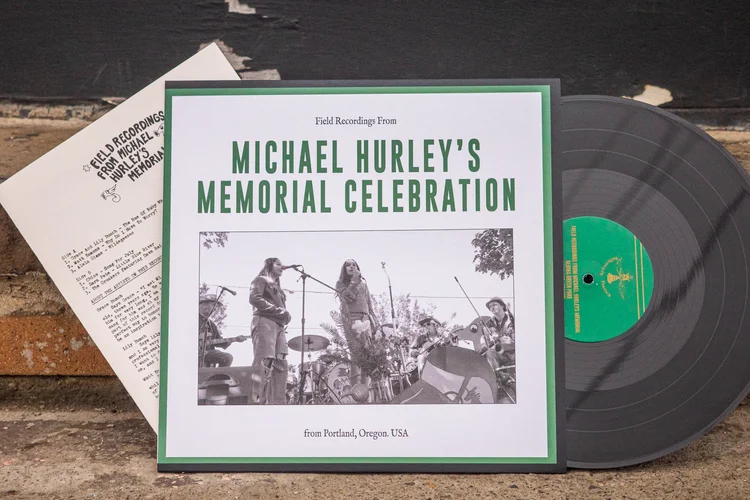
Various - Michael Hurley’s Memorial Celebration
Order This was made in a small run for the record shop and as a gift to our CSR members. The handful of copies we have left are available now!
A recording of some of the best musical moments from Michael Hurley's memorial celebration. Unlike most compilations of covers, all the musicians on this one knew the artist their covering up close and personal. Here, they worked up the courage to publicly perform his songs a month after his passing. It's all no bullshit performances. The musicians range in age from eleven to eighty years old. The songs are raw and emotional as they come. It's a beautiful record! Comes in an old school folkways style wraparound cover and includes a ten page booklet featuring testimonials from the artists, a poem Michael liked, a transcription of a speech Michael made and other rants and raves. |
|
|
|
|
MR-028
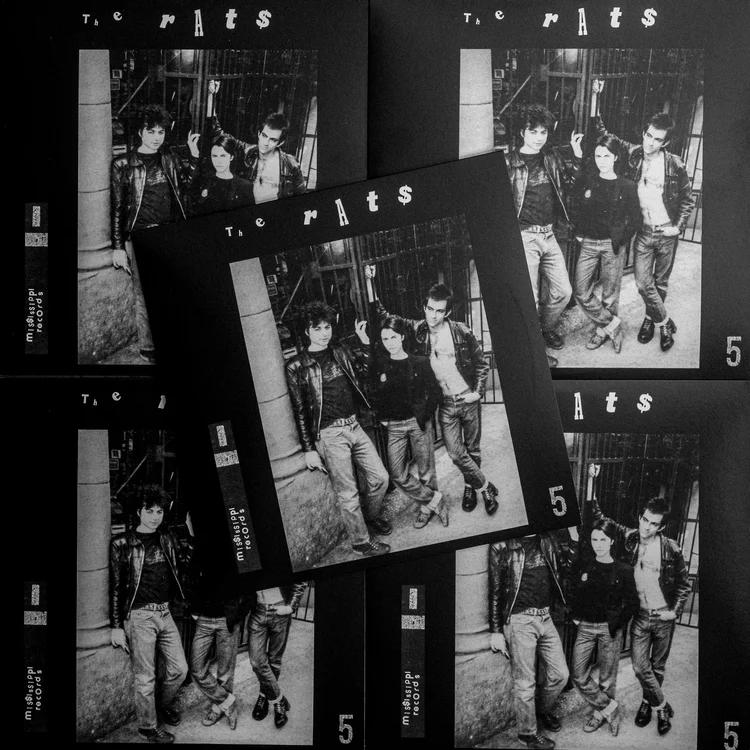
The Rats - The Rats
Listen / Order This is it! Fred and Toody Cole (Dead Moon, The Range Rats, Pierced Arrows, etc) first ever record together! A primitive punk masterpiece. The perfect mix of sophisticated songwriting mixed with the rawest rock imaginable. Ground zero for Portland punk, remastered but still lo fi. |
|
|
|

|
The MerKaBa Brotherhood
S/T
Roman Norfleet (The Cosmic Tones Research Trio, Be Present Art Group) and Andre Raiah (Brown Calvin of Brown Calculus, Be Present Art Group) draw from esoteric texts, sacred imagery, and mystic thought, shaping sound into space, tone, and pulse. It's a spare and almost geometric record featuring sax, keyboard and percussion. |
|
|
|
|
|
|
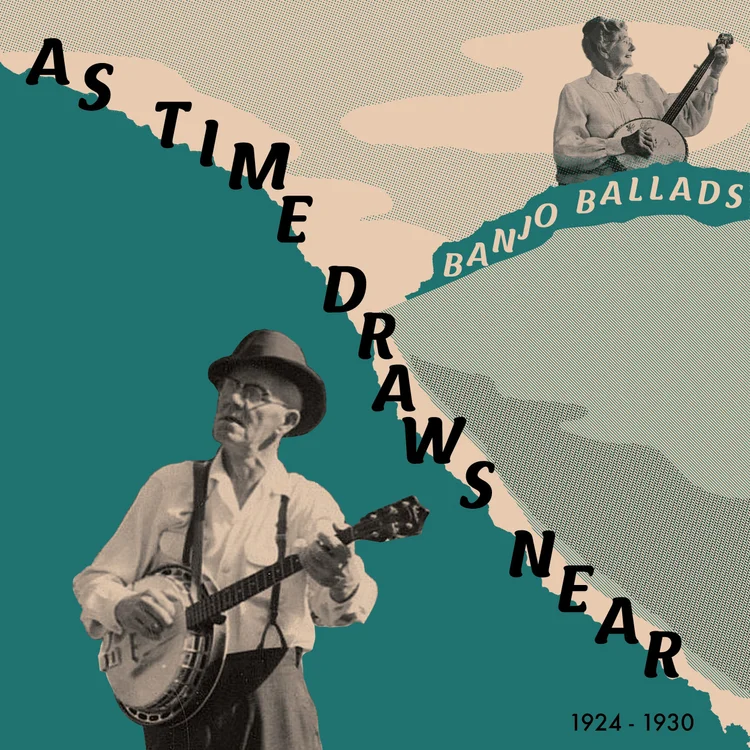
An austere and dialed compilation of 1920's and 1930's ballads. All plaintive solo vocals accompanied by the banjo. No dance songs. Instead you get intense very American tunes about existential angst, murder, love, mystical happenings and so on. The mana. As far as we know, this is the first record to compile purely hard hitting banjo ballads from the golden 78 era. A treasure.... |
|
|
|
This one is on repeat for us!!! Twelve years in the making, a new record by Portland's idiosyncratic master of ultra modern folk music Dragging An Ox Through Water. Old school electronic oscillations and blips meet solid guitar playing and singing. The lyrics alone are worth the price of admission. Nothing obvious is ever said and every word gleens with layers of meaning. Dragging An Ox Through Water is Brian Mumfords' cult long running art music project. Beloved in Portland. Willfully underground. The real stuff. A modern masterpiece. |
|
|
|
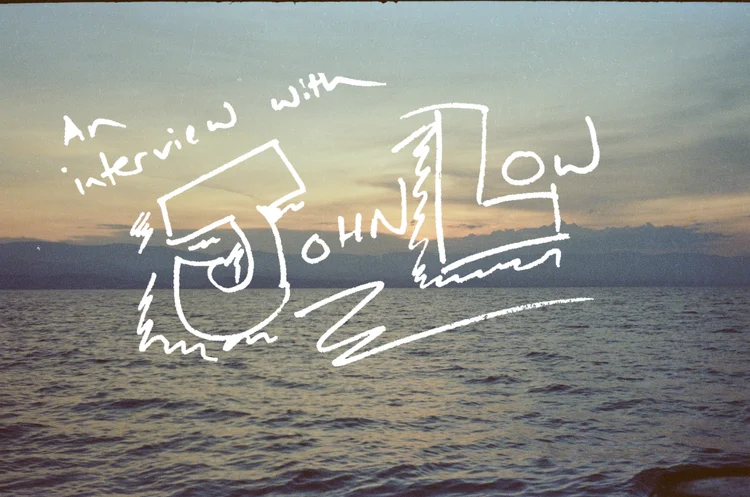
Five Decades of African GuitarsJohn Low’s recordings for John Storm Roberts’ Original Music label have been a touchstone for our little label since the beginning. Maybe it’s his background as a guitarist, or his proficiency in Swahili, or just the way he approaches people, but John’s recordings sound different. Artists seem at ease with him, the sessions loose and full of laughter. Sometimes John plays or sings along. The recordings feel collaborative, a shared moment between artists. It was a dream to hear the master tapes of these legendary recordings, and to work with John and musician/scholar Cory Seznec to compile Bulayo and a second volume, which is coming later this year. On Bulayo, you can hear music John recorded in Kenya, Tanzania, Zambia, and the Congo in 1979. I wrote to John with some questions, and he graciously replied while on holiday in Greece. Read on… All photos by John Low |
|
|
|
The cover of the Bulayo liner notes, Zambia |
|
|
Cyrus: Hi John, can you tell me about how this journey came together. Where were you in your life and how did you decide to take this trip? What was your goal? John Low: It was 1979 and I was 34, single, and a community worker in Leeds in Yorkshire (UK). Two strands came together: a need to return to the Africa of my childhood; and an urge to study African guitar styles, sparked off by Hugh Tracey’s two wonderful African guitar albums. The goal initially was to just to learn African guitar finger-styles and use cassette recordings as an aid. Writing about the music only came later, much encouraged by Gerhard Kubik, that great musicologist and cultural researcher.
CM: How long were you on the road? How did you finance your trip? JL: I was on the road (through Katanga, Zambia, Malawi and Tanzania) for about 6 months. I saved up about £1,000 to finance the trip. This was extra to what I spent on airfares, a back-pack, a Marantz cassette recorder (the latter recommended by Lucy Duran who was hugely supportive and working then at the British Sound Archive) and two beat-up second-hand acoustic guitars. One was Romanian and cost I seem to remember £6 while the other was a Gallo bought from a junk shop in Folkestone, for about £10. Why two guitars? I’d realised that guitars and their accessories were less available in Africa than they had been in the 1950s and 60s. So, if I found a musician who no longer had a guitar, he could play one while I tried to copy him on the other. The fact that my £1000 actually lasted for most of the trip was heavily reliant on the great hospitality I received from the musicians and and their families, from many other kind people, and from my own family in Kenya.
|
|
|
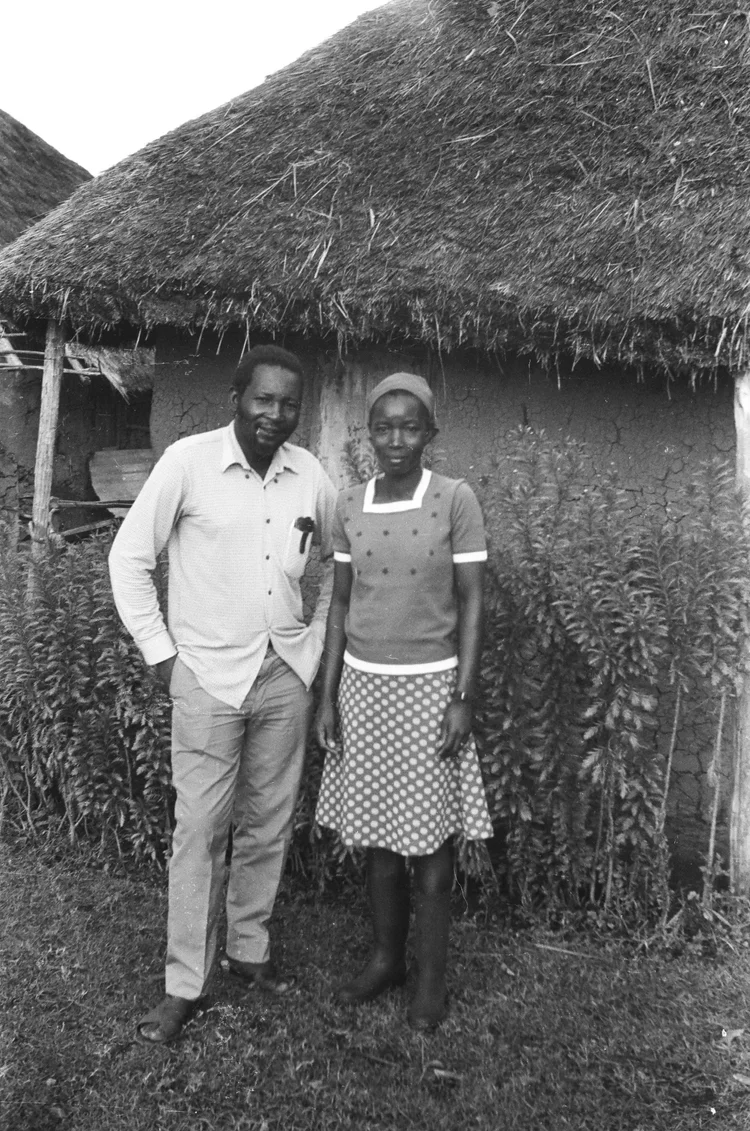
Jimmie Lasco and his wife at their home in Shinyalu Market, near Kakamega |
|
|
CM: How did the artists see your journey and your request to learn / record? How did you convince them to make these recordings? JL: I can’t think of a single example of when a musician refused to work with me. Several needed payment, but some didn’t. I encountered some suspicion, but actually not all that much, that I would be financially profiting from the recordings that I made. Overwhelmingly, I had the feeling that the musicians were pleased that a foreigner wanted to study and play their music. So generally the musicians I met were happy to let me record them.
CM: Who impressed or surprised you the most? Was there anyone you really wanted to meet that you couldn't? JL: I fell in love with Losta Abelo’s guitar songs, and I kicked myself many times afterwards for not spending much longer with him. It was fascinating to find out how Jean-Bosco Mwenda managed to produce intricate and sometimes contrapuntal patterns on the guitar with just thumb and index in his right hand (this by the way a quasi universal practice in African acoustic guitar finger-styles). I had a great time hanging out with Spokes Chola and his kalindula band in Chingola, Zambia; but unfortunately the recordings I made with them (all at live events in clubs and beer-halls) were of poor quality. Francis Kitime was extremely generous with me, and very patient in explaining and teaching his guitar styles; he was incidentally the only guitarist I met who used thumb and index, middle and ring fingers to pluck the strings. More than that, he was a wonderful song-writer who had captured in his guitar songs the history and culture of his own Hehe people. The only guitarist I tried to meet but failed to contact was Paul Machupa near Mombasa, Kenya. I called at his home but he was out. Also in Kenya, I wanted to study with Ben Obolla (aka Ben Blastus Obulawayo) and actually stayed with him for a few days in his home near Kendu Bay on Lake Victoria; sadly however he had played no guitar for years, and couldn’t play his songs for me.
|
|
|
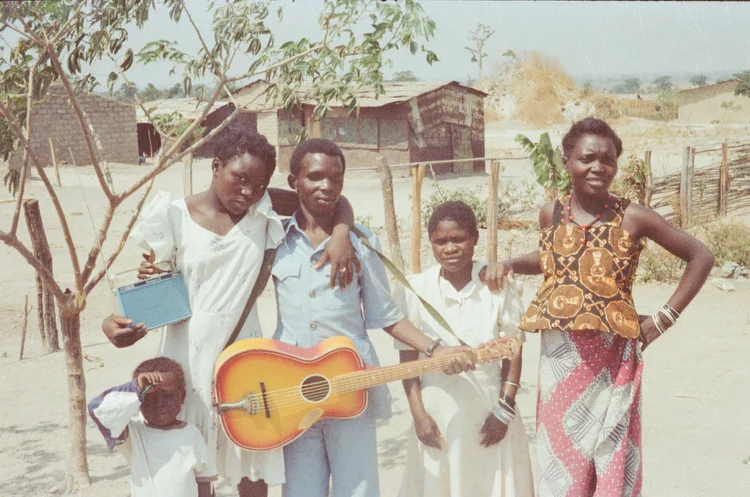
Spokes Chola outside his home in Chingola, Zambia, with his family. |
|
|
CM: What was it like working with John Storm Roberts to release your music the first time around? JL: I never met John Storm Roberts face-to-face - when in the late 1980s and 1990s we worked together on three albums (one on guitar songs; one on Somali urban music; and one on Beja music in Sudan’s Red Sea Province), he was in the US, I in York, England. It was John who contacted me and expressed interest in our collaborating on these albums. He and the team at Original Music were great to work with: they took the selected tracks from my cassettes, produced the master tape, and John and I collaborated on the notes. The final edit had John’s concise, deft, effortlessly-hitting-the-nail-on-the-head writing style all over it. I should add that John’s ‘Black Music of Two Worlds’, and what he wrote about the Nairobi music scene in the 1960s, where great sources of inspiration when I was planning my own trip.
|
|
|
|
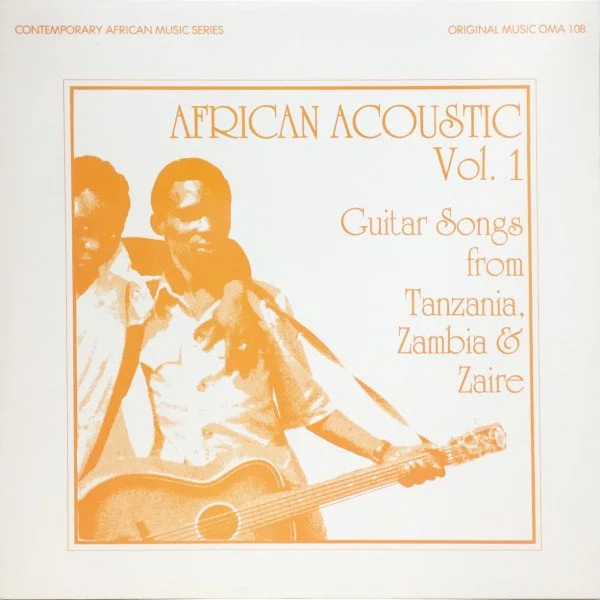
Original Music’s LP of John’s field recordings, 1988 |
|
|
|
CM: How did your work end up in the British Library? JL: I had a deal with Lucy Duran that she would provide me with cassettes, on the understanding that the British Sound Archive would keep a copy of all my recordings. The British Sound Archive was eventually absorbed into the British Library in London, where there is now a ‘John Low East Africa Collection.’ This, and all other collections in British Library Sounds are currently inaccessible, to due a major cyber attack a couple of years ago.
CM: How does it feel to return to this music after all these years? What do you hope new audiences will get from it? JL: I don’t really feel I am ‘returning’ to the music - it’s remained a constant presence in my life. I often listen to it, as well as continuing to play many of the guitar songs myself (which I occasionally post up on YouTube). In many ways I’ve continued to work on the music - writing articles and books, doing an African guitar tutorial with Stefan Grossman, teaching African songs in a world music choir, and playing in a small Yorkshire-based band which specialises in African and Latin American songs (our repertoire includes covers of songs by Bosco, Losta Abelo, Fundi Konde, Edouard Masengo and George Sibanda). What I hope new audiences will gain from listening to the Mississippi albums is a clear sense of the richness of these African guitar finger-styles (which flourished in the 1950s and 1960s), but also an appreciation of their lyrics which reveal so much about the musicians and the lives they led. As much as country blues in the US, to take just one example, this genre of African guitar songs deserves to be preserved and remembered. If people should be inspired to learn and play these songs, or even to carry out further work on them, that as far as I’m concerned would be ample reward for my own modest contributions! CM: Anything else you'd like to add? JL: Just that it has been a great honour and privilege to work with you and the team at Mississippi Records, who have breathed huge enthusiasm into the whole project, as well as with Cory Seznec who helped us select the tracks and offered much other useful advice. It makes me very happy to know that a younger generation of musicians are taking on the hugely important task of preserving African guitar styles, and of course other similar types of music from all over the world. More power to your elbows (and picking fingers!)
|
|
|
The Cosmic Tones Research Trio Long Play Festival
Sun, May 3
6:00pm
Public Records
233 Butler Street, Brooklyn, NY TICKETS HERE |
|

|
|
|
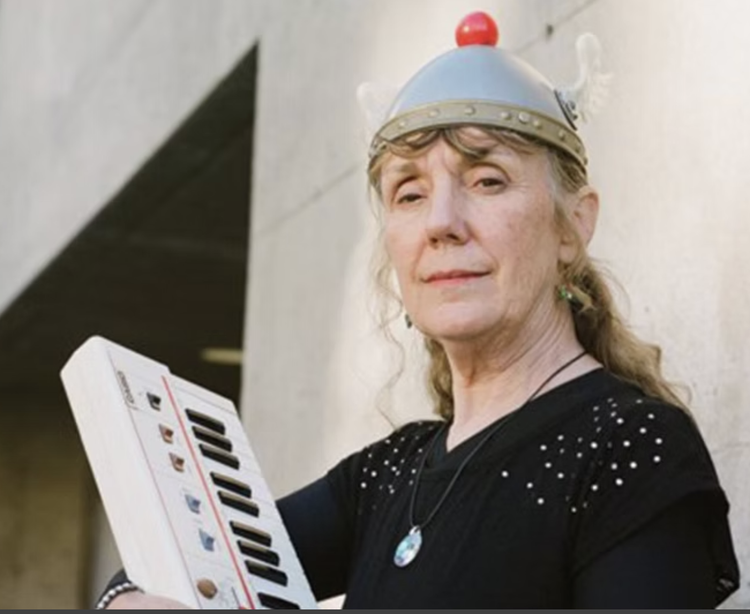
The Space Lady + Kadi Rae & the Nochmal Ensemble June 11, 2026, 7:00 PM The Village Ballroom 704 NE Dekum St Portland, OR TICKETS HERE |
|
|
|
|
We shared some contemporary Iranian music recs with Christina Hazboun at Bandcamp. Listen here…
|
|
Community Links Mississippi Records Website
Visit the site to get our label's records and tapes direct from us - we are constantly rotating our selection of mixtapes, new records from labels we distribute, and discounted out-of-print records, so be sure to check in often!
www.mississippirecords.net Mississippi Records Portland Store
We are open EVERY DAY from 12 to 7 PM!
(our stereo repair and retail shop is open Friday - Sunday, 1 to 6 PM).
WE ARE EXCITED TO BUY YOUR RECORD COLLECTIONS!
Please drop by anytime to sell stuff. We always have a buyer on duty and you do not need an appointment. Paying out 50 - 60% of our retail price (NOT - dumb internet prices though...Mississippi store prices) Email mississippierici@gmail.com if you have any questions about the shop. Mississippi Records CSR
Our Community Supported Records program directly supports the label. Get each Mississippi LP at a discount as it's released, no matter how limited, plus special schwag and gifts on occasion. Limited to 300 spots. The CSR contributions help us pay for record pressings and generally stay afloat.
More details here…
www.mississippirecords.net/csr
Mississippi Records Bandcamp
There are hours and hours worth of albums available for free listening, and a whole lot of the releases are "pay what you want" if you want to download ‘em. Check it out -
https://mississippirecords.bandcamp.com/
Toody Cole/Junkstore Cowboy
Toody Cole has shuttered her Junkstore Cowboy Shop in our basement, but that does not mean you can't get your Dead Moon / Pierced Arrows / Rats / Range Rats / Tombstone schwag and records still from her badass online store.
https://www.deadmoonusa.com/
Red Hook Mutual Aid
We’re proud to have a studio in Brooklyn’s Red Hook neighborhood, which hosts one of the most active mutual aid groups in the city. Learn more about the organizing activity here.
|
|
|
|